Understanding How Overtime Wages Impact Your Mortgage Application
Applying for a mortgage involves a thorough review of your financial stability, with income being a primary factor. While overtime pay can significantly boost your earnings, its fluctuating nature presents a unique challenge for lenders. This section will clarify how mortgage providers assess overtime income and what you need to know to ensure it contributes positively to your application.
The Lender’s Perspective on Income Stability
Lenders prioritize income stability when assessing your eligibility for a mortgage. Their core objective is ensuring you can consistently make monthly payments for the life of the loan. Unpredictable income sources like overtime present a higher risk, often subject to economic shifts, seasonal demands, or changes in employer policy. To qualify you, lenders calculate your ‘qualifying income’ – the portion of your earnings they deem reliable and sustainable.
- Why Stability Matters: For a 30-year loan, lenders need strong assurance your income stream won’t suddenly vanish or drastically reduce, jeopardizing repayment. Base salaries and guaranteed wages are viewed as more stable than fluctuating overtime.
- The Risk Factor: Overtime often depends on external factors like project availability or company performance. This variability makes it harder for lenders to confidently project future earnings from overtime alone.
- Anticipating Your Question: ‘Why can’t they just use my total annual income?’ Lenders analyze income trends, not just a single year’s total. A year with high overtime might be an anomaly. They guard against over-extending a borrower who might not sustain that income, protecting both parties from future financial strain.
Key Takeaway: Lenders value consistent, predictable income over volatile earnings, viewing overtime as less reliable unless specific criteria are met.
When Overtime Can Be Counted Towards Your Mortgage
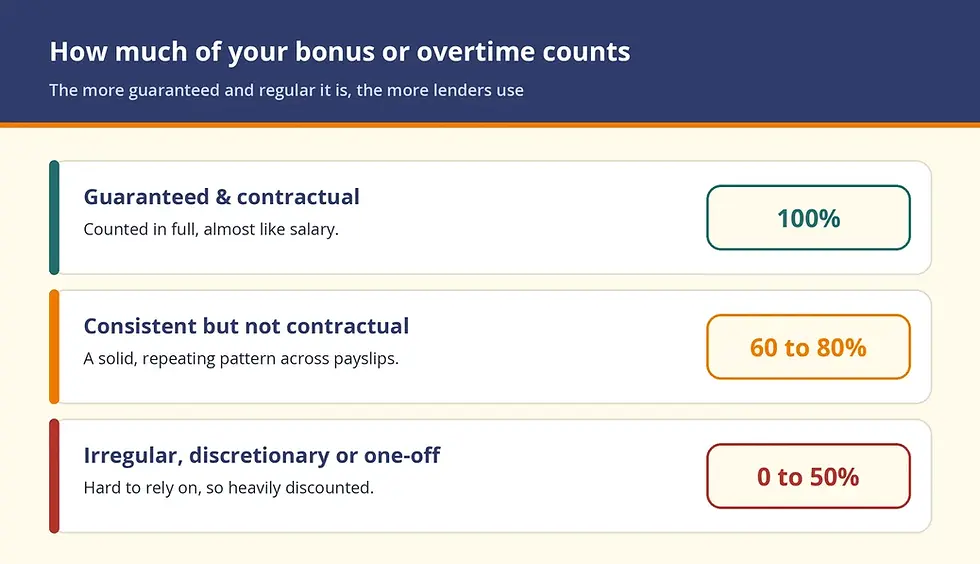
Despite its variability, overtime income can be considered by mortgage lenders if it meets stringent criteria for consistency and likelihood of continuation. The key is proving a historical pattern of receiving overtime that is expected to persist.

- The Two-Year Rule: Most lenders, across conventional, FHA, and VA loan programs, require a minimum two-year history of consistent overtime earnings. This period helps establish a reliable average and confirms the overtime isn’t just a temporary boost.
- Consistency is Crucial: It’s not just about having received overtime for two years; regularity matters. Gaps or significant fluctuations could reduce the counted amount or cause lenders to disregard it entirely.
- Averaging the Income: If your overtime history qualifies, lenders typically average your overtime earnings over the past two years (sometimes three). For example, if you earned $10,000 in year one and $14,000 in year two, a lender might use an average of $12,000 annually ($24,000 / 2) as qualifying overtime income.
- Employer Verification: Lenders often require employer verification confirming your overtime is likely to continue at a similar rate, usually via an employment verification letter.
- Anticipating Your Question: ‘What if I just started getting significant overtime?’ If you lack the required two-year history, or your overtime only recently became substantial, most lenders will not count it towards your qualifying income. They need that established track record to mitigate risk.
Key Takeaway: Overtime can be counted if you demonstrate a consistent, multi-year history of receiving it, which lenders will average and verify with your employer.
Documenting Your Overtime Income Effectively
Successfully including your overtime wages in your mortgage application hinges on providing thorough and accurate documentation. Preparing these documents in advance streamlines the process and prevents delays.
- Pay Stubs: You’ll typically need your most recent pay stubs (last 30-60 days). These should clearly detail regular pay, overtime hours, and overtime earnings.
- W-2 Forms: Your W-2s from the past two years are critical. Lenders use these to confirm your reported annual income, including overtime, aligning with the two-year history. They look for breakdowns of regular vs. overtime wages if available, or compare total income year over year.
- Employment Verification (VOE): Your lender will send a VOE form to your employer, requesting details on base salary, position, start date, and crucially, affirmation regarding the history and likelihood of continuation for your overtime income. Ensure your employer understands the importance of timely, accurate information.
- Tax Returns (If applicable): While not primary for W-2 employees, if your situation is complex or involves other income sources, your lender might request tax returns. For overtime, W-2s are generally sufficient.
- Anticipating Your Question: ‘What if my employer is slow to respond to verification requests?’ This is a common hurdle. Proactively communicate with your employer’s HR or payroll department about the upcoming verification. Explain its importance for your mortgage application and offer to facilitate the process by providing lender contact information.
Key Takeaway: Comprehensive documentation, including pay stubs, W-2s, and strong employer verification, is essential to validate your overtime income for mortgage qualification.
Strategies to Bolster Your Overall Mortgage Application
Even if your overtime income doesn’t fully qualify or only partially counts, several powerful strategies can strengthen your mortgage application and improve your chances of approval. Focusing on these areas makes a significant difference.
- Improve Your Credit Score: A higher credit score (e.g., FICO 740+) signals responsible borrowing, potentially leading to better interest rates and offsetting some perceived income risk. Pay bills on time, reduce credit card balances, and avoid new credit before applying.
- Reduce Your Debt-to-Income (DTI) Ratio: Your DTI is a critical metric: total monthly debt payments divided by gross monthly income. A lower DTI indicates more disposable income for mortgage payments. Paying down credit cards, car loans, or other personal loans before applying significantly improves this ratio.
- Increase Your Down Payment: A larger down payment reduces the loan amount, lowering your monthly mortgage payment and DTI. It also signals greater financial commitment and stability to lenders, reducing their risk.
- Build Cash Reserves: Having a healthy emergency fund or significant cash reserves after your down payment demonstrates financial prudence. Lenders prefer seeing funds available to cover payments in case of unexpected circumstances.
- Consider a Co-Borrower: If your income or credit profile alone isn’t strong enough, adding a co-borrower with stable income and good credit can significantly strengthen the application. Remember, the co-borrower’s debt also factors into the DTI.
Key Takeaway: Beyond just your overtime, improving your credit score, reducing debt, increasing your down payment, and building reserves are powerful ways to enhance your overall mortgage eligibility.
| Loan Type | Overtime Income Requirement | Key Consideration for Overtime |
|---|---|---|
| Conventional (Fannie Mae/Freddie Mac) | Minimum 2-year history, likely continuation. | Averages overtime over 24 months. May require employer verification of continuation. |
| FHA Loan | Minimum 2-year history, reasonable likelihood of continuation. | Averages overtime over 24 months. Requires documentation and employer attestation. |
| VA Loan | Minimum 2-year history, stable and reliable. | Averages overtime over 24 months. Lender must reasonably expect it to continue. |
| USDA Loan | Minimum 2-year history, confirmed by employer as stable and recurring. | Averages overtime over 24 months. Similar to other government-backed loans. |
- Start Preparing Early: Begin tracking your overtime income and collecting W-2s and pay stubs well in advance of your application.
- Maintain Consistent Employment: Avoid job changes or significant shifts in your work schedule leading up to and during your mortgage application process. Lenders prefer stability.
- Communicate Clearly with Your Lender: Be upfront about your income sources, including overtime, and ask how they prefer to handle it. Every lender may have slightly different nuances.
- Understand Your DTI: Know your current debt-to-income ratio and look for ways to reduce it, as a strong DTI can offset some income variability.
- Request Employer Verification Proactively: Talk to your employer’s HR or payroll department early to ensure they are prepared to respond to lender verification requests promptly.